Right now
Play in your browser
Tap the button, sign in, and take a round with your device exactly as it is. It is the same browser route the demo uses.
- Ready ahead of the first tower
- Works on a phone, a tablet or a laptop
Before the first tap
A round lasts seconds, which leaves little time to think once the crane is moving. So make the choices before that point: a practice run in the free demo, the session amount, the stake, the difficulty and the exit block.
Tower Dash is an instant tower-building game from InOut Games, played as a short round with a crane and a stack of blocks.
The frame below loads the free demo that InOut Games hosts. It opens straight away, it runs in the browser you are reading this in, and the fun balance starts at 1 000 000, so the first towers cost nothing.
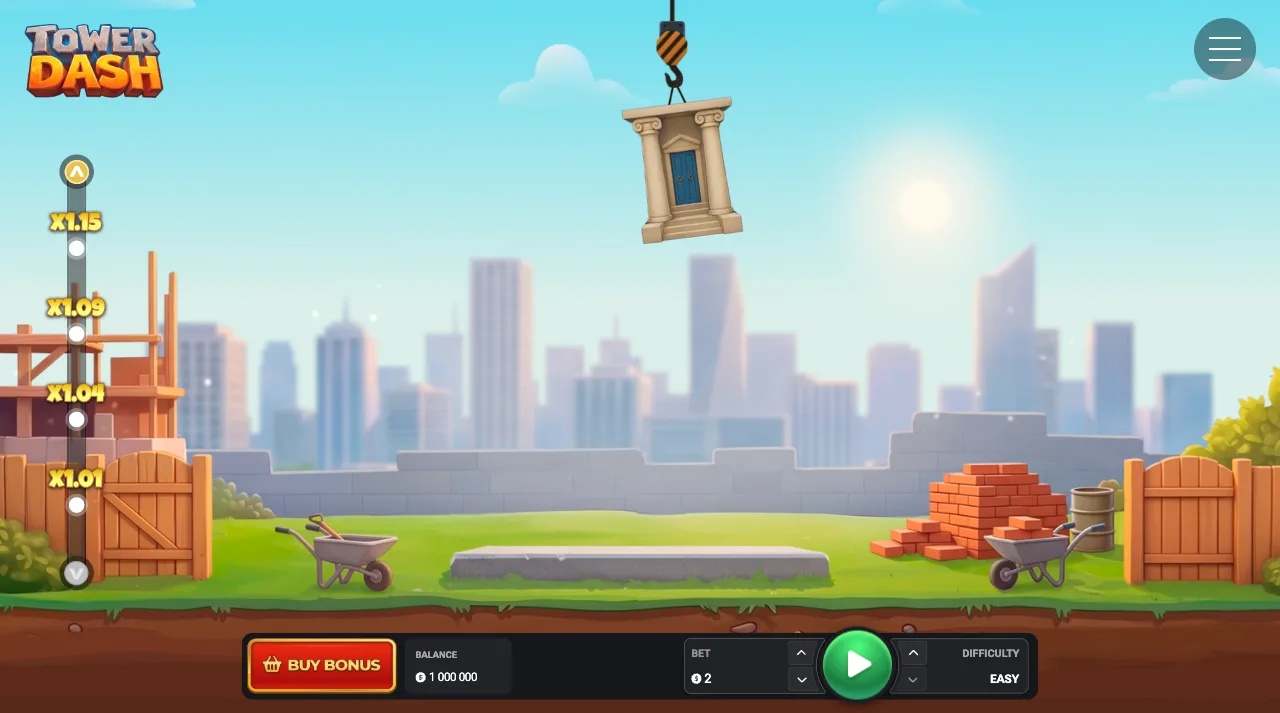
Free provider demo. The balance in the frame is fun money and the limits are shown in USD.
Both reach the same game on the same operator account. The choice depends on how often you intend to play.
Right now
Tap the button, sign in, and take a round with your device exactly as it is. It is the same browser route the demo uses.
Later
Install the Tower Dash app from our partner and the same game opens from the home screen.
If the operator account offers a deposit limit, set it before the first real-money round.
Five of them are made before the crane moves, which is why they are listed first.
Pick the session amount that suits your budget and keep to it when you deposit.
Many operator accounts include a deposit limit tool. Check whether yours does, and set it before the first staked round.
Divide the session amount by the number of rounds you want to play. The result is a per-round stake that lets the session last as long as intended.
Easy allows a tower of up to 40 blocks, Medium 38 and Hard 35. The setting also fixes the chance of placing a block and the potential payout.
Choose the block number before the round starts. A target set in advance is easier to keep than one chosen while the multiplier is rising.
Drop each block, read the Cash Out button after each landing, and press it at the block you named.
All six can be rehearsed in the demo above for free.
A short summary of the game ahead of the first stake.
RTP 95.5%, a long-run average across a very large number of rounds.
After the demo
With the stake, the difficulty and the exit block chosen, the preparation for a staked round is complete.
A round of Tower Dash is over in seconds, and the setup deserves more time than that. Setting the deposit, the limit and a stake first means the pause between two blocks only asks for one decision.
Five minutes spent on the session amount, the stake and the exit block removes most of those in-round decisions. What remains is a tap per block and a button you have already decided when to press.
The reason is practical. The multiplier is highest at the same moment that continuing is most expensive, so a choice made beforehand is more reliable than one made on the spot.
The demo embedded above is hosted by the provider and starts straight away. It starts with a fun balance of 1 000 000, so the ladder can be learned before playing for real.
Touch response and screen size differ between devices, and the crane will feel slightly different on each one. In the demo, watch a full pass before the first release, drop three or four blocks and cash out early on purpose. On a desktop the Space key drops the block.
The two bonus buys belong to the real-money game. Touch the skies! costs 50 times the bet and builds automatically in Medium mode with three attempts. Build your city! costs 100 times the bet and sums the multipliers of several automatically built towers. At a bet of 2 they cost 100 and 200, so the stake you set decides the price.
The most useful habit in this game is choosing a block number before the round starts. A block number works better than a multiplier target, because the ladder differs between Easy, Medium and Hard while the block count is easy to follow on any of them.
Choose it before the first tap: six, eight, or whatever suits the difficulty. Then play the round to that number and press Cash Out when you reach it.
Sometimes the tower would have gone three blocks higher. Try it once in the demo, then open Tower Dash and keep to the number in a staked round.
A session ends for one of three reasons: the planned number of rounds is played, the limit is reached, or the game has stopped being enjoyable. None of them depends on the balance being at a particular level.
A session with a planned ending stays in your hands, and the final tower becomes one more round.
Decide which ending you are aiming at before you deposit.
Real-money Tower Dash is available from India through our button, on the partner account. Rounds are short and a phone is usually within reach, so the game fits into small gaps in the day. A limit set inside the operator account, where one is offered, keeps working when you are tired late in the evening. To check what your account provides, sign in and look at the account settings.
The game card lists its bet range in USD, from 0.12 to 100, with a maximum win of 100 000 USD, and the operator’s cashier shows the amounts that apply to your account. Keep the stake small enough that every tower stays a relaxed round, cash out at the block you named, and close the game when the planned session is finished. Then play Tower Dash.
After a session, open My bet history in the game menu. It lists the stake, difficulty, multiplier reached and result of every tower, so you can see whether the stop you planned matched what you did. The Provably fair settings show the seed values and hash for any round, which confirms each outcome. A simple review habit is to note the three towers where you cashed out and the three where you pushed further, then set the target for the next session from that picture. The bonus buys scale with the stake: at a bet of 2 they cost 100 and 200.